
Scene: It’s 3:00 a.m. The rest of the world is fast asleep and yet there you are laying in the darkness; your mind racing like a thoroughbred hopped up on amphetamines. You’re thinking about the novel you’ve just finished writing, basking in the glory of committing that last sentence to the page, knowing you’ve just achieved a huge milestone in your journey as an author.
Suddenly, a horrible thought comes to the forefront—one that almost immediately extinguishes every ounce of good juju you’ve felt for the past few hours. Now, instead of tweeting to your 200 followers that you have become a writing deity, you panic.
What if everyone hates my story?
This, of course, leads to a soul-crushing maelstrom of other questions—ones you’d most likely rather not think about.
Do I really have what it takes?
Have I wasted days/months/years of my time and energy?
Will an agent even bother reading past the first few pages before they toss my work in the incinerator?
STOP! Take a breath. And another. Aaaaaand another.
Are you calm now? Great! Because I have news for you. More than likely your novel will be rejected. For some of you, it may be rejected more than once. Actually, there’s a good chance that the first time you submit your novel to an agent it will remain on the slush pile collecting dust for all eternity.
I know what you’re thinking now: “Gee! Thanks for the pep talk Kimberly! You’ve made me feel so much better!”
Well, before you decide to delete your manuscript (and possibly come after me brandishing torches and pitchforks), here’s something that will cheer you up: YOU. ARE. NOT. ALONE. In fact, you’ve just joined an exclusive club of authors who have lost sleep, sanity, and even clumps of hair worrying that their work will never see the fluorescent lighting of their local bookstore.
Fear of rejection for a writer is not only expected—it’s also normal. After all, if you were too overconfident, you wouldn’t have committed so much time and energy to making your first (or even second) draft as perfect as you could make it. You would have simply typed a mishmash of meaningless words on every page, ignored errors, and submitted your work without a care in the world.
Basically, you would have written a bad book.
Now you’re probably thinking, “That’s not really helping, Kim.” Okay, but bear with me for a second because you might enjoy hearing this next part.
Many great authors—some of whom you may actually worship—have experienced rejection at some point in their careers. Unless you’re an indie author who self-publishes (and believe me, they experience it too), rejection in the writing world is much more common than you might think.

You might be surprised to find out that Stephen King’s first novel, Carrie, was rejected 30 times—even thrown in the trash by King himself—before someone finally found the intellectual wherewithal to publish it. The book went on to sell over one-million copies in its first year, and now the King of Horror is a household name.
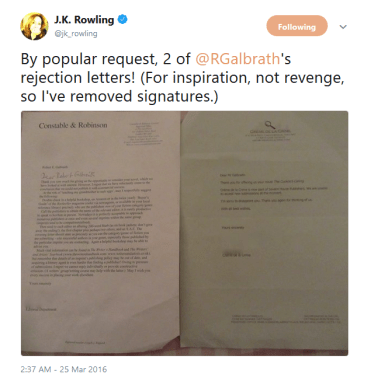
I pinned my 1st rejection letter to my kitchen wall because it gave me something in common with all my fave writers! https://t.co/ZmGNWDdF7x
— J.K. Rowling (@jk_rowling) March 25, 2016
J.K. Rowling—whose Harry Potter series has sold over 500-million copies worldwide according to Pottermore—was rejected 12 times and told to “not quit her day job” before Harry Potter and the Sorcerer’s Stone was picked up by Bloomsbury.
If that’s not enough to boost your confidence to new heights, here are a few other “rejects” of note:
- Twilight by Stephenie Meyer (14 rejections)
- The Notebook by Nicholas Sparks (24 rejections)
- The Time Traveler’s Wife by Audrey Niffenegger (25 rejections)
- A Wrinkle in Time by Madeleine L’Engle (25 rejections)
- Gone With the Wind by Margaret Mitchell (38 rejections)
- The Help by Kathryn Stockett (60 rejections)
Now, imagine how often those agents and publishers who rejected these books kick themselves in the butt today. Kind of makes you smile a bit, doesn’t it?
Anyway, the point is this: Just because one agent (or several) don’t like your book, that doesn’t necessarily mean that the book is bad. It just means that it either 1) might need a little more polish before it’s ready for the world or 2) you simply haven’t found the right agent. Yet.
Keep this in mind throughout your career—as a writer you should not only expect rejection, but you should also embrace it. View every letter, email, phone call, or “no-response” of rejection as a learning experience, and ask yourself questions as to why you think your work was passed over (note: not all agents will provide an explanation). Once you’ve compiled a list, address those concerns.
And by all means, tack that rejection letter on the wall as a badge of honor! You now have something in common with some of the most awesome writers on the planet!
Most importantly, never let one rejection deter you from submitting your work again (and again, and again), even if it takes 60 tries. You might find that #61 will land you the perfect agent, the perfect publisher, and the perfect contract!
Need more of a confidence boost? Here are a few links that might help!
“Famous Books Rejected by Publishers”
 Aristeia